When mineral particles fail to disperse?
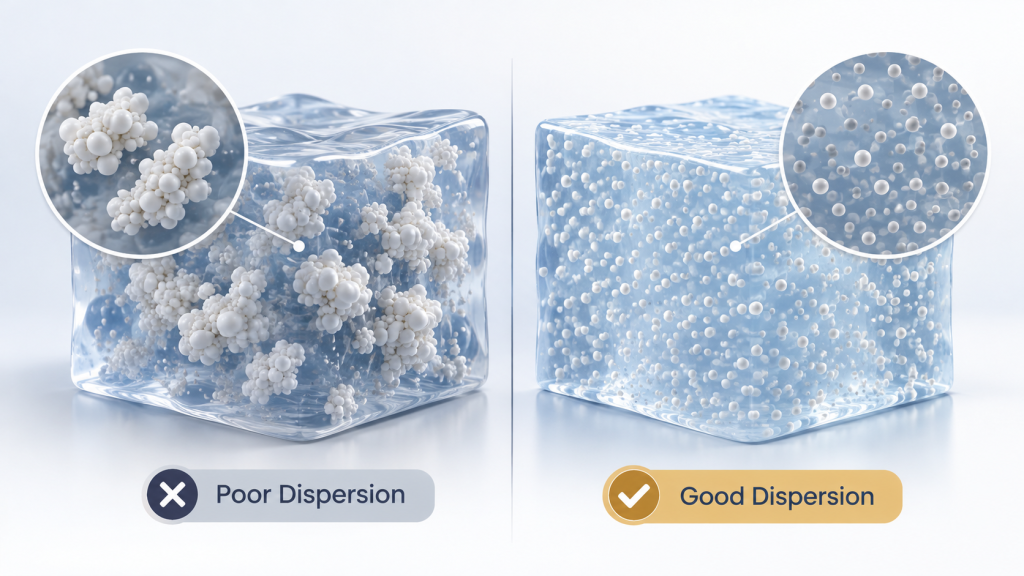
Poor dispersion occurs when a material is not adequately separated and distributed throughout a host matrix. Instead of achieving a consistent distribution, particles may remain in clusters or form localized concentrations within the system.This lack of uniformity can influence how the material behaves, interacts with other components, and contributes to the overall performance of the final product. Achieving effective dispersion is therefore essential to maintaining consistency in material performance and supporting reliable processing and product quality.
What makes dispersion difficult?
Achieving uniform dispersion is influenced by several interconnected factors. The characteristics of mineral particles, their surface properties, interactions with the surrounding matrix, and the conditions of processing all contribute to how effectively particles separate and distribute throughout a material system.
Understanding these factors is essential to identifying the right engineering approach for improving dispersion behavior.
01
Particle Characteristics
Particle size, size distribution, shape, and morphology influence how mineral particles interact, move, and separate from one another within a material system.
02
Surface Properties
The surface condition and energy of mineral particles affect their ability to be wetted by the surrounding matrix, influencing how easily they can be incorporated and dispersed.
03
Interfacial Interactions
Interactions between mineral particles and the surrounding matrix influence compatibility, particle separation, and the stability of dispersion within the material system.
04
Processing Conditions
Mixing equipment, shear intensity, temperature, and processing time all influence how effectively particle agglomerates can be broken down and distributed throughout the material.
Beyond dispersion: What is at stake?
Poor dispersion can extend its impact far beyond the distribution of mineral particles within a system.
Agglomerates and non-uniform particle distribution can influence product consistency, surface quality, mechanical performance, and processing stability. The extent of these effects depends on the formulation, material characteristics, and processing conditions.
Understanding these connections helps identify where dispersion-related issues can translate into broader product and manufacturing challenges.
01
Surface Quality & Appearance
Undispersed particle agglomerates may contribute to surface irregularities, visible defects, and inconsistencies in the appearance of finished products.
02
Product Consistency
Non-uniform particle distribution can create variations in material structure and properties, potentially affecting the consistency of the final product.
03
Processing Stability
Variations in particle distribution can influence material flow and behavior during processing, potentially making manufacturing conditions less consistent.
04
Mechanical Performance
Particle agglomeration and non-uniform distribution can influence stress transfer and structural continuity, potentially affecting the mechanical properties of the material.
Engineering the way minerals interact
At BOOTRAP, powder dispersion is approached as an engineering challenge that goes beyond the mineral itself.
We consider how particle characteristics, surface properties, and interactions with the surrounding material system influence dispersion behavior under actual processing conditions.
By understanding these relationships, we focus on engineering mineral materials through appropriate selection, surface treatment, and modification strategies — developing solutions aligned with the requirements of each application..
01
Material understanding
Understanding mineral characteristics, particle specifications, and surface behavior provides the foundation for selecting and developing materials suited to specific formulation requirements.
02
Interface engineering
Evaluating and engineering the interactions between mineral particles and surrounding components helps address compatibility, wetting, and interfacial behavior within the material system.
03
Process-oriented design
Considering actual processing conditions and application requirements helps align material characteristics and engineering strategies with the demands of real manufacturing environments.
Application-Aligned Mineral solutions
By combining mineral knowledge, interfacial engineering, and process understanding, we develop mineral solutions tailored to the specific requirements of each application.
What better dispersion can make possible?
Effective powder dispersion can influence more than the distribution of mineral particles within a material system. By improving particle separation, wetting, and interaction with the surrounding matrix, it may contribute to more consistent material behavior and improved performance across different stages of processing and end-use.
The potential effects depend on the mineral characteristics, formulation design, and processing conditions.
01
More uniform particle distribution
Improved dispersion can help distribute mineral particles more evenly throughout the material matrix, reducing localized concentrations and supporting greater structural uniformity.
02
Improved surface quality
Reducing particle agglomeration may help minimize dispersion-related surface defects, contributing to smoother and more consistent product appearance.
03
More consistent material properties
A more uniform particle distribution can support greater consistency in the structure and properties of the final material, depending on the formulation and application.
04
More stable processing behavior
Better dispersion may contribute to more uniform material behavior during processing, helping reduce variations associated with poorly distributed particles.
Turning better dispersion into business value
The value of improved powder dispersion goes beyond material performance. Depending on the formulation and processing conditions, more effective dispersion can contribute to better product consistency, more efficient manufacturing, and greater control over production outcomes.
These improvements can create opportunities to optimize costs, reduce production-related losses, and enhance the overall value of the final product.
01
Cost optimization
More effective dispersion may create opportunities to optimize formulation costs by improving how mineral materials perform within the overall system, rather than evaluating them solely on their purchase price.
02
Production efficiency
More consistent material behavior can support smoother processing, reduce dispersion-related interruptions, and help improve manufacturing efficiency.
03
Quality consistency
A more uniform material structure may help reduce product variation, support consistent quality, and minimize the costs associated with defects and rework.
04
Product value enhancement
Improved dispersion can help manufacturers make better use of material properties, creating opportunities to enhance product quality and achieve greater value from the final formulation.
Engineered solutions for better dispersion
Explore BOOTRAP’s engineered mineral solutions, developed to address powder dispersion requirements and enhance material performance across industrial applications.
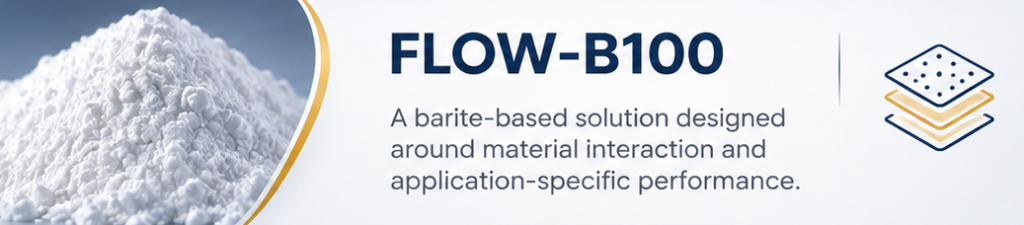
Introducing the FLOW Series — a family of engineered solutions built around two widely used industrial minerals: Calcium Carbonate and Barite, designed to address material interaction and application-specific processing requirements.